
In this blog, learn about the fundamental principle of counting and how to count the number of permutation and combination in a easier manner.
Fundamental Principle of Counting
There are two rules of counting. The multiplication rule and the addition rule.
Multiplication rule
For a task to be completed, two events A, B need to be performed. If the event A can occur in m different ways, following which event B can occur in n different ways, then the total number of ways in which task can be completed is m x n.
For instance, the number of ways a person can dress who has 3 pants and 2 shirts is 3 x 2 = 6.
Addition rule
For a task to be completed, either of the two events A, B should be performed, but not both. If the event A can occur in m different ways, and event B can occur in n different ways, then the total number of ways to complete the task is m+n.
What is a Permutation?
A permutation is an arrangement in a definite order of a number of objects taken some or all at a time. The number of permutations of n different objects taken r at a time, when repetition is not allowed is  , when repetition is allowed is nk.
What is a Combination?
A combination is an arrangement in which the order of elements arranged doesn’t matter. The number of combinations of n different objects taken r at a time, when repetition is allowed is  , when repetition is not allowed is
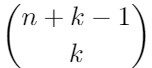 .
Factorial notations
Factorials come handy to calculate permutation and combination. Mainly because, 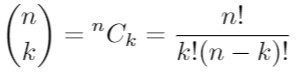
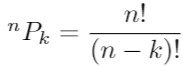 .
Getting familiar with factorial notation comes in handy while solving problems of Permutation and Combination.
Permutation and Combination Theorem 1
Theorem 1:
Let there are n objects. In these n objects we have p1 objects of one kind, p2 objects of second kind, … pk objects of kth kind and the rest if any, are of different kind. Then the number of permutations of the n objects taken all at a time equals to 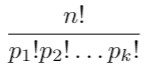
Permutation and Combination Theorem 2
Theorem 2:
This theorem tells us how permutation and combination of n different objects taken r at a time, when repetition is not allowed are related as 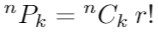
This theorem tells us that to find the number of permutations we can find the number of combinations and multiply it with r! ( use the result carefully, as certain conditions apply).
Example:
Find the number of combinations and permutations of choosing 4 cards out of a 52 card deck?
As discussed earlier, the number of combinations are 52 choose 4 = 
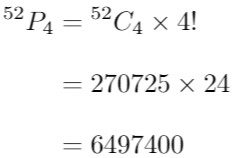
Using the above theorem, we could easily get the number of permutations from number of combinations.
In continuation, the number of permutations are =
We hope, this blog(permutation and combination) was helpful.
Picked For You With Mathematical Induction
- JEE Main 2021 Solved Question Paper
- Principle of Mathematical Induction and Solved Examples
- Sequences and Series with solved problems
To solve and ask more and more questions download Kunduz app for free.