4 4 2 Set Two Passage II The Earth suffered the greatest
Last updated: 5/11/2023
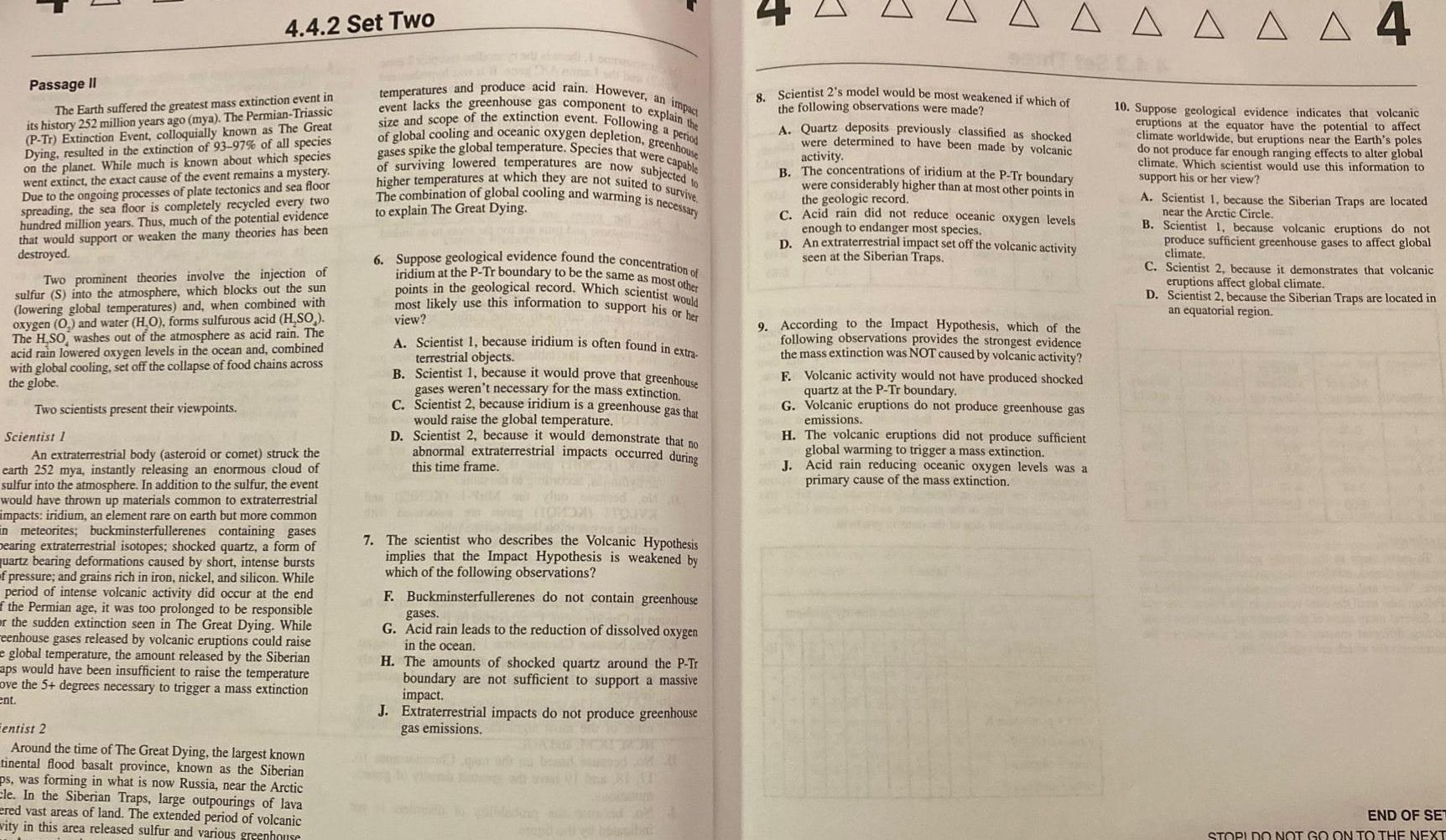
4 4 2 Set Two Passage II The Earth suffered the greatest mass extinction event in its history 252 million years ago mya The Permian Triassic P Tr Extinction Event colloquially known as The Great Dying resulted in the extinction of 93 97 of all species on the planet While much is known about which species went extinct the exact cause of the event remains a mystery Due to the ongoing processes of plate tectonics and sea floor spreading the sea floor is completely recycled every two hundred million years Thus much of the potential evidence that would support or weaken the many theories has been destroyed Two prominent theories involve the injection of sulfur S into the atmosphere which blocks out the sun lowering global temperatures and when combined with oxygen 0 and water H O forms sulfurous acid H SO The H SO washes out of the atmosphere as acid rain The acid rain lowered oxygen levels in the ocean and combined with global cooling set off the collapse of food chains across the globe Two scientists present their viewpoints Scientist 1 An extraterrestrial body asteroid or comet struck the earth 252 mya instantly releasing an enormous cloud of sulfur into the atmosphere In addition to the sulfur the event would have thrown up materials common to extraterrestrial impacts iridium an element rare on earth but more common in meteorites buckminsterfullerenes containing gases bearing extraterrestrial isotopes shocked quartz a form of quartz bearing deformations caused by short intense bursts of pressure and grains rich in iron nickel and silicon While period of intense volcanic activity did occur at the end the Permian age it was too prolonged to be responsible or the sudden extinction seen in The Great Dying While eenhouse gases released by volcanic eruptions could raise e global temperature the amount released by the Siberian aps would have been insufficient to raise the temperature ove the 5 degrees necessary to trigger a mass extinction ent Fentist 2 Around the time of The Great Dying the largest known tinental flood basalt province known as the Siberian ps was forming in what is now Russia near the Arctic cle In the Siberian Traps large outpourings of lava ered vast areas of land The extended period of volcanic wity in this area released sulfur and various greenhouse temperatures and produce acid rain However an impact event lacks the greenhouse gas component to explain the size and scope of the extinction event Following a period of global cooling and oceanic oxygen depletion greenhouse gases spike the global temperature Species that were capable of surviving lowered temperatures are now subjected to higher temperatures at which they are not suited to survive The combination of global cooling and warming is necessary to explain The Great Dying 6 Suppose geological evidence found the concentration of iridium at the P Tr boundary to be the same as most other points in the geological record Which scientist would most likely use this information to support his or her view A Scientist 1 because iridium is often found in extra terrestrial objects B Scientist 1 because it would prove that greenhouse gases weren t necessary for the mass extinction C Scientist 2 because iridium is a greenhouse gas that would raise the global temperature D Scientist 2 because it would demonstrate that no abnormal extraterrestrial impacts occurred during this time frame 7 The scientist who describes the Volcanic Hypothesis implies that the Impact Hypothesis is weakened by which of the following observations F Buckminsterfullerenes do not contain greenhouse gases G Acid rain leads to the reduction of dissolved oxygen in the ocean H The amounts of shocked quartz around the P Tr boundary are not sufficient to support a massive impact J Extraterrestrial impacts do not produce greenhouse gas emissions the bea hat A A A A A 4 8 Scientist 2 s model would be most weakened if which of the following observations were made A Quartz deposits previously classified as shocked were determined to have been made by volcanic activity B The concentrations of iridium at the P Tr boundary were considerably higher than at most other points in the geologic record C Acid rain did not reduce oceanic oxygen levels enough to endanger most species D An extraterrestrial impact set off the volcanic activity seen at the Siberian Traps 9 According to the Impact Hypothesis which of the following observations provides the strongest evidence the mass extinction was NOT caused by volcanic activity F Volcanic activity would not have produced shocked quartz at the P Tr boundary G Volcanic eruptions do not produce greenhouse gas emissions H The volcanic eruptions did not produce sufficient global warming to trigger a mass extinction Acid rain reducing oceanic oxygen levels was a primary cause of the mass extinction J 10 Suppose geological evidence indicates that volcanic eruptions at the equator have the potential to affect climate worldwide but eruptions near the Earth s poles do not produce far enough ranging effects to alter global climate Which scientist would use this information to support his or her view A Scientist 1 because the Siberian Traps are located near the Arctic Circle B Scientist 1 because volcanic eruptions do not produce sufficient greenhouse gases to affect global climate C Scientist 2 because it demonstrates that volcanic eruptions affect global climate D Scientist 2 because the Siberian Traps are located in an equatorial region END OF SET STOPI DO NOT GO ON TO THE NEXT