Is there a relationship between confidence intervals and
Last updated: 7/14/2022
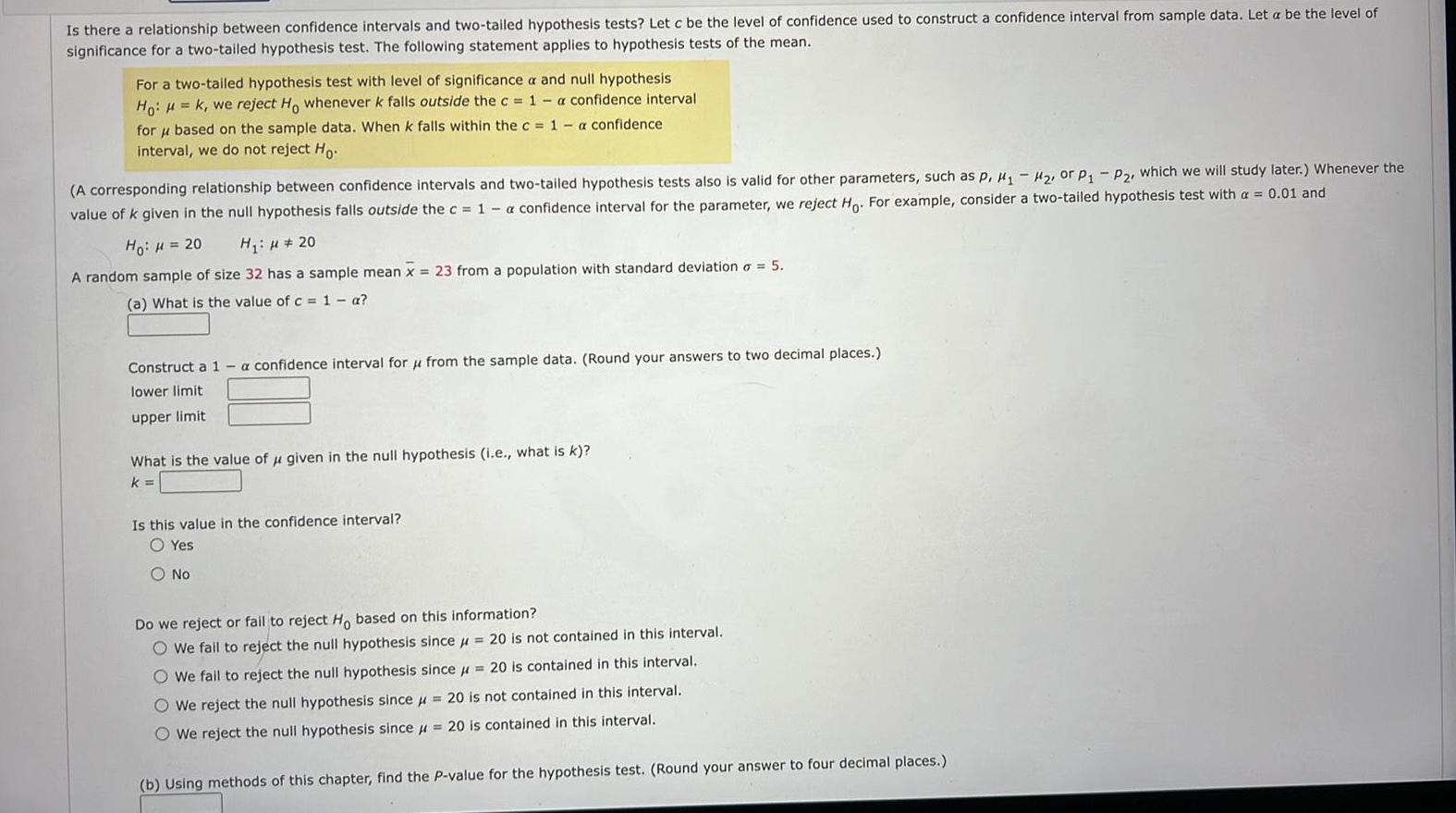
Is there a relationship between confidence intervals and two-tailed hypothesis tests? Let c be the level of confidence used to construct a confidence interval from sample data. Let a be the level of significance for a two-tailed hypothesis test. The following statement applies to hypothesis tests of the mean. For a two-tailed hypothesis test with level of significance a and null hypothesis Ho: H=k, we reject Ho whenever k falls outside the c = 1 - a confidence interval for μ based on the sample data. When k falls within the c = 1 - a confidence interval, we do not reject Ho. (A corresponding relationship between confidence intervals and two-tailed hypothesis tests also is valid for other parameters, such as p, H₁ - H₂, or P1 P2, which we will study later.) Whenever the value of k given in the null hypothesis falls outside the c = 1 - a confidence interval for the parameter, we reject Ho. For example, consider a two-tailed hypothesis test with a = 0.01 and Ho H = 20 H₁: μ # 20 A random sample of size 32 has a sample mean x = 23 from a population with standard deviation o = 5. (a) What is the value of c = 1 - a? Construct a 1 - a confidence interval for from the sample data. (Round your answers to two decimal places.) lower limit upper limit What is the value of μ given in the null hypothesis (i.e., what is k)? k= Is this value in the confidence interval? Yes No Do we reject or fail to reject Ho based on this information? We fail to reject the null hypothesis since μ = 20 is not contained in this interval. We fail to reject the null hypothesis since = 20 is contained in this interval. We reject the null hypothesis since μ = 20 is not contained in this interval. We reject the null hypothesis since = 20 is contained in this interval. (b) Using methods of this chapter, find the P-value for the hypothesis test. (Round your answer to four decimal places.)