To calculate the concentration of a solution using acid-base
Last updated: 7/6/2022
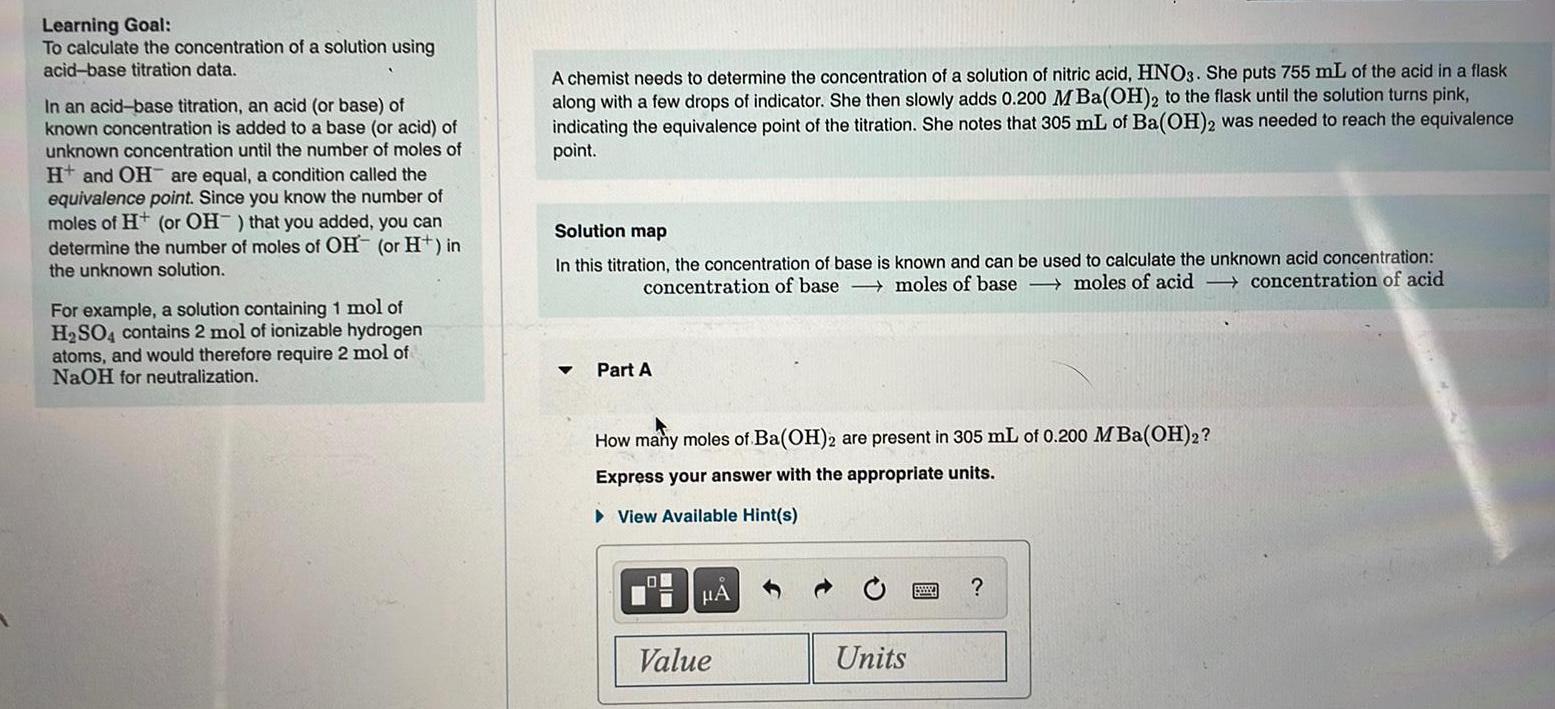
To calculate the concentration of a solution using acid-base titration data. In an acid-base titration, an acid (or base) of known concentration is added to a base (or acid) of unknown concentration until the number of moles of H+ and OH- are equal, a condition called the equivalence point. Since you know the number of moles of H+ (or OH- ) that you added, you can determine the number of moles of OH (or H+) in the unknown solution. For example, a solution containing 1 mol of H₂SO4 contains 2 mol of ionizable hydrogen atoms, and would therefore require 2 mol of NaOH for neutralization. A chemist needs to determine the concentration of a solution of nitric acid, HNO3. She puts 755 mL of the acid in a flask along with a few drops of indicator. She then slowly adds 0.200 M Ba(OH)2 to the flask until the solution turns pink, indicating the equivalence point of the titration. She notes that 305 mL of Ba(OH)2 was needed to reach the equivalence point. Solution map In this titration, the concentration of base is known and can be used to calculate the unknown acid concentration: concentration of base moles of base moles of acid concentration of acid Part A How many moles of Ba(OH)2 are present in 305 mL of 0.200 M Ba(OH)2? Express your answer with the appropriate units.